Swimming in the calm of the water, unburdened by heavy equipment, has the ability to dissolve the hustle and worries of the surface. Even a slow, relaxed glide through the water warms up every muscle, providing a gentle yet effective workout. However, to start enjoying the unfamiliar environment, one needs to learn to swim efficiently, exerting minimal effort. By understanding how freedivers train, you can choose the optimal methodology that suits you best.
What Freediving Training is Based On
The structure of any freediver’s training is based on the unique physiology of the neuromuscular system when the body is in a state of breath-holding. You can read more about the physiology here . Freediving with prolonged breath-holding challenges the body’s reserve capabilities and systematically expands these reserves through consistent training.
The main goal of any freediving training system is to develop resistance to reduced oxygen levels and decrease the sensitivity of receptors to carbon dioxide levels.
The depletion of energy reserves during training stimulates supercompensation — within one to two days after the initial workout, energy reserves will double as the body prepares for the next load. Reserve energy depots in cells become activated, metabolism speeds up, and oxygen absorption efficiency increases.
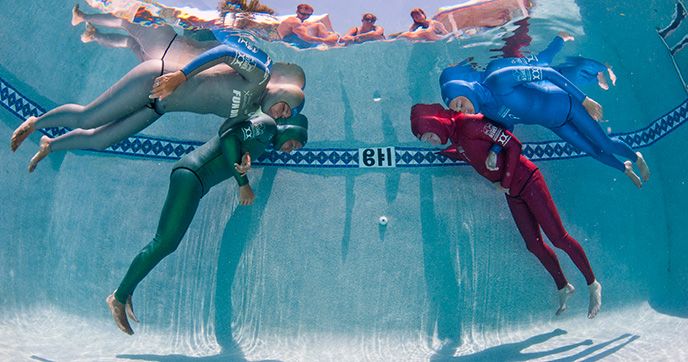 Freediving training
With the help of special training, a freediver prepares their body to absorb oxygen more efficiently.
For each swimmer, the oxygen debt threshold is unique and depends on:
- The adaptability of receptors to increased levels of CO2.
- The individual level of adaptation of blood vessels, muscles, and organs to oxygen deprivation and the speed of metabolism.
- The fullness of energy depots in cells.
Freediving Training Methods
At the initial stages of preparing for a dive, a freediver should primarily focus on increasing lung capacity and managing nervous tension under the unfamiliar underwater conditions. It is necessary to adjust the load on the heart and monitor blood pressure; over time, endurance will improve.
The course and intensity of the workload depend on the freediver’s internal sensations. It’s important to listen carefully to your body, avoid excessive strain, and work frequently but in measured doses.
Warm-Up
A workout should never begin without a warm-up. The warm-up prepares the body for the upcoming load. Warming up increases the oxygen capacity of the blood.
Sample warm-up routine: 300 m freestyle, alternating every 50 meters with breathing on the third/fifth/seventh/seventh/fifth/third stroke. This could also be breaststroke with breathing after every one/two/three/three/two/one cycle. Monofin swimming with breathing on the third/fourth/fifth/fifth/fourth/third cycle.
Distance Swimming
Distance swimming with faster breathing is an effective tool for saturating the body with oxygen. However, overly long distances can lead to prolonged headaches resembling migraines. To avoid these side effects, the distance during 2-3 months of training should be split into 4 sets of 100 m freestyle, breathing every fifth stroke. Then progress to 2 sets of 200 meters, 400 meters, and 2 sets of 400 meters. Once these sets are mastered, move on to six sets of 100 m, breathing every seventh stroke. Over time, your breath-to-stroke count will become second nature, and you’ll discover the joy of simply counting and listening to your body.
Variable Exercises
These exercises involve intermittent activation of blood flow and breathing. During the initial set, moderate oxygen deprivation occurs. This is followed by relaxed swimming, during which the oxygen deficit is replenished, and the second round usually experiences less oxygen debt.
Variable exercises might look like this: 25 meters breaststroke with diving/75 meters freestyle, totaling 400 meters. With fins: 25 meters diving/25 meters with free breathing, totaling 600 meters.
Interval Freediving Training
Interval training involves short distances with breath-holding interspersed with brief rest periods. The main goal of interval exercises is to train the heart. During rest, oxygen is consumed faster, and the next round should begin shortly before full heart rate recovery — this way, oxygen uptake increases with each set. Typically, the oxygen absorption peak occurs at the fourth segment.
Exercises: 8 Intervals of 25 Meters Diving Breaststroke or with Fins
The workout consists of performing 8 intervals of 25 meters, diving using either breaststroke or fins, with a ten full breaths-rest in between. Gradually, the series of intervals is increased to 16 segments of 25 meters, reducing the rest period by one deep breathing cycle. The cycles of segments can be alternated.
Video: How Classes Take Place in Freediving Courses (Open Water)
Freediver Pool Training
50-Meter Distances with Repeats and Breath Holds
The goal of this exercise is to train the body to use muscle glycogen for energy production in anaerobic conditions. The second attempt is made 2-3 minutes after the first, without waiting for full recovery, still feeling the discomfort from lactic acid. Perform 2-3 sets of 4 intervals of 50 meters, diving using breaststroke or fins. Rest periods: two minutes/90 seconds/1 minute. Between sets, you can recover for up to 20 minutes with free swimming.
The schemes proposed above are only a part of the system in which many swimmers include yoga for diving. Learn more in the article…
Training alone is strictly prohibited. Each of these workouts is a serious challenge to your body’s capabilities. Therefore, it is absolutely essential to observe safety techniques and rely on your instinct for self-preservation, even if this isn’t your first time hearing the word freediving!